Showing posts with label Australia. Show all posts

Sunday, 6 October 2013

Barrenjoey Lighthouse, NSW

At the end of September 2013, we watch on the news as fire broke out at the Barrenjoey Headland in the northern beaches of Sydney. For those not familiar with this area, the beach and the lighthouse doubles as a Summer Bay in the popular Australian TV series, Home and Away.

One week later, we visited the site to witness the aftermath of the fire. It is amazing that the lighthouse and cottages remain intact while the bushland around it was ravaged. Here is the link to the ABC site for some photos during the fire outbreak.

Here are some photos I took using the Nokia Lumia 920.


The National Park rangers and volunteers are looking for volunteers to assist at the end of October beginning of November 2013. If you're in the area or want to volunteer, please contact the rangers.

Sunday, 3 March 2013

Photos from Bathurst

These are some photos taken at Bathurst, NSW. I am very impressed with the clarity and detail captured by the Nokia Lumia 920.


Saturday, 5 January 2013

TIP: Autofocus

There are two ways to engage the autofocus (AF) on a windows phone device. You can either:
  1. Use the shutter release button. Press the shutter half-way. This will utilise the center AF area. Once on focus you will hear a beep to indicate that you can reframe your shot. The press down on the shutter button to take the shot.
  2. Tap on the subject you want to focus on. This will cause the camera phone to utilise a smaller AF area. It also takes the shot once focusing is complete.
One thing I have noticed with the AF system is that the tap to autofocus is much less reliable than the shutter button method. Here are two shots taken at the same time. You can clearly see the difference.

Tap AF used to take this frame. The focus point was the eyes.
Center AF used to focus. Once focused the frame was composed and shot taken.

100% crops comparing the two AF modes.

Sunday, 30 December 2012

Sometimes it is about the camera!

I obtained the yellow Nokia Lumia 920 as soon as it was released in Australia. Prior to this, I owned an Android based phone which at the time of purchasing was one of the phones with the highest mega pixels rating at 8 mega pixels. This was at a time when most phones were at 5 mega pixels.

Choosing a phone that can capture good quality photos is important to me. Because let's face it, sometimes it is about the camera!

My two main reasons: family and travelling.

 My phone doesn't just allow me to communicate with my family and friends. The visual quality and richness in my interactions through video-calling, MMS texting and posting photos to share is important. The ability to instantly share a moment is important.

I enjoy roadtrips and travelling. Being a solo traveller, I am mindful of the weight I carry around with me. For my recent trip, I purchased a point and shoot camera which has picture quality of a DSLR. While I do own a DSLR, I find that it is not always convenient to carry one around. My phone is always with me.

We have set a challenge for ourselves to bring forward the idea that Nokia Lumia 920 phone camera has a place in photography, mindful of it's limitations, but also it's place in everyday life. My focus is in the everyday life and how well I can marry up my interest in photography with the one item I carry around with me.

 These were the photos taken last night while walking around the Sydney foreshores.

Taken near my cousins place while walking on the boardwalk. I enjoy the drama in this photo.
Taken looking at the lights on the bridge as Sydney prepares for New Years Eve
Taken near Luna park. Looking at the Bridge and Opera House
 I did wonder when I took this shot whether a tripod for phones would ever become available!

Wednesday, 26 December 2012

Controlling expectations - What the Lumia 920 cannot do well

The first entry for this blog set up my expectations for the Lumia 920. I expected it to perform better than a mobile phone to a point where it can challenge point and shoot cameras. The plus for me is the fact that you can take decent photos on a whim. I mean who doesn't carry their mobile phones around these days. It is perfect for the happy snapper, the impromptu moment or when you don't want to carry a digital SLR around.

Hints of this product targeting the casual shooter is apparent in Nokia's selection of features for the phone. The Lumia 920 features a 8.7 MP 1/3 inch sensor with a 26 mm (equivalent) F2.0 Carl Zeiss lens with optical stabilisation. This means for the normal person:
  • Wide angle lens
  • Fast lens for good low light performance
  • Decent MP for printing photos. More than enough for facebook or sharing across the internet.
For a photographer is means:
  • Fixed aperture (F2.0) will make controlling depth of field difficult. This would be very apparent for landscapes with an estimated hyperfocal length of 83 m! In other words, it would be difficult to take a landscape shot with all of the frame in focus
  • Small sensor size, means more noise and artefact as we push longer exposure in low light
  • Small MP and hence don't print any photos in large format.
Today I decided to see where the differences really lie between my digital SLR and the Lumia 920 in terms of landscape photography. More specifically, I wanted to see the how well each device performed for high dynamic range (HDR) landscape photography. Each device was allowed 3 shots of +/- 1 EV from regular exposure. Roughly the same landscape was framed the camera was secured on a tripod and a camera phone holder for the Lumia 920.

Photomatrix was used for the HDR produced by the digital SLR, while the HDR camera and Thumba was used to create the HDR effect for the Lumia. I should point out that the desktop tools for HDR photography is much more mature than the mobile equivalent. HDR camera at the time of publication is a very basic tool with no means to adjust the final merged image.

Comparing the sensor size. My trusty digital SLR has a huge advantage. The Lumia's sensor is a dwarf in comparison.
The first challenge for the Lumia was focus. With a fixed aperture of F2.0 where would you ask the camera phone to focus for all the frame to be 100% sharp? As mentioned above the hyperfocal length is 83 m, but this point may be some ripples on the horizon or tree branches swaying in the wind. It literally became a 'guessimate' for the 83 m on a feature that has enough contrast for the autofocus system to focus.

After 3 attempts, we were able to get this 'in focus' HDR.

Lumia 920 HDR at West Point. 3 exposures were used for the shot.
What you can see is good definition on the clouds and the capture is not too bad for a camera phone. There are some 'ghosting' since the HDR camera program did not compensate for foliage movement. The trees as a result have this artefact and lacked detail as the different exposures are used to create the HDR.

This image compares very poorly against my digital SLR and its HDR program photomatrix.

D200 HDR at West Point. 3 exposures were used for this shot.
Immediately you can see just how superior the digital SLR HDR is compared to the Lumia 920 HDR. There is more detail, less noise and things just pop out at you. This is due to a combination of things namely better HDR software, larger sensor and much better optics. Focus isn't an issue for a digital SLR since stopping down the aperture to F13 gave a hyperfocal length of only 2.4 m. This makes focusing to infinity much easier and contributed greatly to obtain the perfect shots first time and with minimum repeated attempts.

The astonishing difference can be seen in the detail captured between devices.

Side by side comparison of a digital SLR and Lumia 920 HDR.
It isn't surprising that the Lumia for landscapes lacks details in the capture. The sensor is only 5% of the size of a digital SLR sensor. Its resolving power would be considerably weaker. You can also see from this composite the noise is more apparent for the Lumia 920 picture. Again this is due to its small sensor.

Looking at purely resolving power now.

Night and day difference in terms of resolving power of the devices.
The 100% crops shows how much detail the digital SLR captured. You can clearly see the rocks and their definition. On the Lumia, these structures are just blobs. On reflection these results are not surprising at all. The digital SLR has a professional grade lens which is worth about 3-4X a Lumia 920s. The digital SLR camera isn't the latest and greatest, but does an amazing job on landscapes

So what does this all mean? Well in a few words, 'enjoy moments with the Lumia' but for serious photography nothing beats a digital SLR. This can be said for any camera phone, great for your snaps but there are limits. HDR landscape photography is one such limit.

The question begging to be asked is 'will revisions to the mobile HDR software improve the final output?' Most definitely it will, but only in terms of contrast and image saturation of colours. The lack of detail is purely the limitation of the phone's camera system and feature set.

I hope this entry will help readers get the most out of their camera phone. Knowing the strengths and weakness of a platform will improve the images capture on the device.

Monday, 24 December 2012

Ku-ring-gai Chase National Park - Bairne Track

The Ku-ring-gai Chase National Park is the second oldest park in Australia. It is situated north of Sydney and will take you about 40 mins drive to its front gate. It is a hidden gem of a park embedded in what is known as greater Sydney.

We only just discovered this park purely out of curiosity on our way to Palm Beach. What we found is a park full of amazing tracks that we would like to share with the readers.

Our first hike was an easy 4.1 km walk on the Bairne Track (one way). It was a typical day in Sydney, nice and sunny with a pleasant breeze to refresh us during the hike.


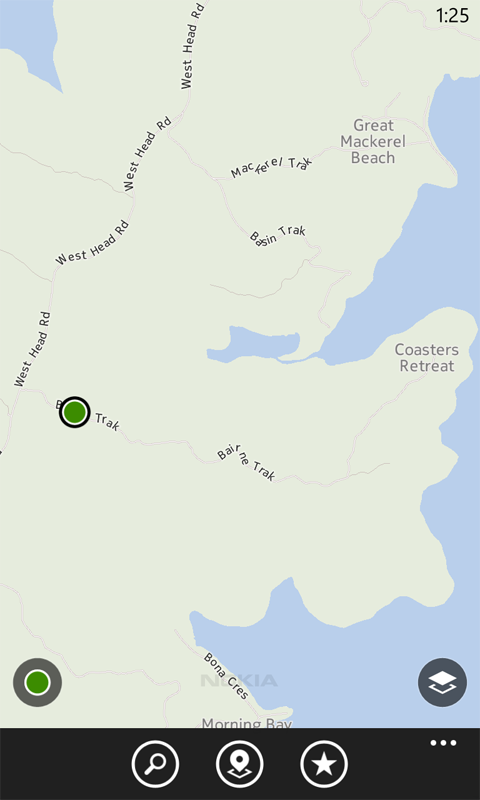
We were surprised that Nokia maps had the track marked. The Portuguese track leading to Coaster retreat was closed on the day. 
Some tips for this track, wear decent footwear. There are lots of rocks of varying sizes that can twist an ankle or cause you to fall on your 'buttocks'. Take plenty of water and wear sunscreen. The Australian sun is notorious, just ask any 'pom' on a Sunday at Manly beach.

The track is generally flat, with some small gradients but nothing difficult. It is a very long track so allow yourself about 3 hours including return. There was a lot of excellent flora of the Australian bush on this track. It really gave us the opportunity to do some macro work and get some excellent shots at very low angles.

This type of photography isn't possible when on the move with SLR gear. The freedom to position the shot independent of a viewfinder was very liberating. We ended the walk all tired, but pleased with the capture of the following shots!

I am not sure what this plant is, the colour and structure caught my eyes. Captured is a very delicate shot that typifies the subject well.
 

An Australian Bull ant. These guys are very aggressive and are not afraid of challenging you. The Lumia allowed us to take a very low angle to see that we were not the only ones out for a hike on that day.
The reverse angle, but boy did the ant looked pissed! Needless to say, we parted journeys shortly after this shot.
A simple composition to highlight the insect trails found on the bark of the trees during out hike.
At the end of the Bairne track is this spectacular view of the bays! This was captured using the panoramic lens on the Lumia 920.